Department of Data Science
Author: Mrs. HEMANI
Introduction
Every day, enormous volumes of data are generated through online searches, social media activity, digital payments, e-commerce platforms, fitness applications, and navigation systems. While this data often goes unnoticed by users, it is continuously collected and analyzed to improve services, personalize experiences, and support decision-making systems.
The technology responsible for this transformation is Data Science. Often described as the backbone of the digital era, data science plays a crucial role in converting raw, unstructured data into meaningful insights. These insights are then used to optimize systems, predict trends, and enhance everyday experiences across industries.
From recommending entertainment content to enabling early disease detection, data science has become an invisible yet powerful force shaping modern life.
What is Data Science?
Data Science is an interdisciplinary field that focuses on extracting knowledge and insights from structured and unstructured data. It combines several domains, including statistics, programming, machine learning, and domain expertise, to interpret complex datasets.
At its core, data science helps organizations answer key questions such as what is happening, why it is happening, and what is likely to happen next. By applying analytical models and algorithms, raw data is transformed into actionable intelligence that supports better decisions, improved efficiency, and predictive capabilities.
In simple terms, data science turns large and complex datasets into useful information that can solve real-world problems.
Data Science in Everyday Life
Personalized Entertainment
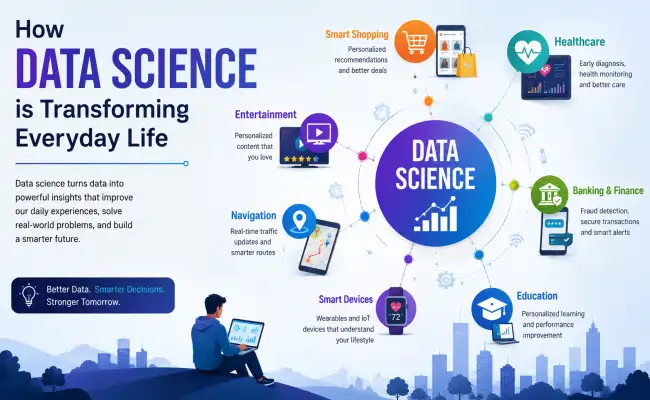
Streaming platforms such as video and music services rely heavily on data science to understand user behaviour. By analyzing watch history, search patterns, and engagement time, these platforms recommend content tailored to individual preferences. This is why users often discover movies or songs that closely match their interests.
Smarter Online Shopping
E-commerce platforms use data science to study browsing history, purchase behaviour, and customer preferences. Based on this analysis, they recommend products, offer personalized discounts, and display targeted advertisements. Predictive algorithms help anticipate what a customer may want even before they search for it.
Navigation and Travel
Navigation systems and ride-hailing applications use real-time data from GPS signals, traffic updates, and user movement patterns. This allows them to suggest optimal routes, reduce travel time, and improve transportation efficiency. Millions of users rely on these systems daily for faster and more accurate navigation.
Digital Banking and Fraud Detection
Modern banking systems depend on data science to enhance security and detect fraudulent activity. Machine learning models analyze transaction patterns and identify unusual behaviour in real time. If suspicious activity is detected, alerts are generated to protect customers and prevent financial loss.
Healthcare and Wellness
In healthcare, data science is transforming diagnostics, treatment, and preventive care. Wearable devices collect continuous health data such as heart rate, sleep cycles, and physical activity. Hospitals and healthcare systems use this data to support early diagnosis, personalize treatment plans, and improve patient outcomes.
Data Science in Social Media
Social media platforms generate massive volumes of data through user interactions such as likes, comments, shares, and posts. This data is continuously analyzed to improve user engagement and platform experience.
Data science enables these platforms to:
- Personalize content feeds based on user interests
- Recommend new connections and communities
- Deliver highly targeted advertisements
- Detect harmful, spam, or inappropriate content
As a result, users experience more relevant, engaging, and personalized digital environments.
The Role of Artificial Intelligence
Data Science and Artificial Intelligence (AI) are closely interconnected. While data science focuses on extracting insights from data, AI uses those insights to make intelligent decisions and automate tasks.
AI systems such as chatbots, virtual assistants, recommendation engines, and smart devices rely heavily on data-driven learning. Without data, AI cannot function effectively; without AI, data science cannot scale its impact in real-world applications. Together, they form the foundation of modern intelligent systems.
Why Data Science Matters
The importance of data science extends far beyond convenience and personalization. It is actively solving complex challenges across multiple sectors, including:
- Healthcare
- Education
- Agriculture
- Finance
- Cybersecurity
- Climate research
- Smart city development
By transforming raw data into meaningful insights, data science enables organizations and governments to make informed decisions, optimize resources, and drive innovation. It has become a key driver of digital transformation across the global economy.
Challenges in a Data-Driven World
Despite its benefits, data science also introduces several important challenges that must be addressed responsibly.
Privacy Protection
As more personal data is collected, ensuring user privacy and responsible data usage is essential.
Data Security
Organizations must protect sensitive information from cyberattacks, breaches, and unauthorized access.
Ethical Use of Data
Algorithms must be designed to remain fair, transparent, and free from bias to ensure equitable outcomes.
Addressing these challenges is critical to ensuring that data-driven technologies remain safe, trustworthy, and beneficial for society.
The Future of Data Science
The future of data science is closely tied to advancements in Artificial Intelligence, the Internet of Things (IoT), Edge Computing, Digital Twins, and Quantum Computing. These technologies are expanding the scale, speed, and complexity of data-driven systems.
In the coming years, data science will play a major role in:
- Developing intelligent smart cities
- Enhancing healthcare systems and medical research
- Supporting climate action and sustainability efforts
- Improving transportation and mobility systems
- Enabling personalized and adaptive education
As digital ecosystems continue to expand, data science will become even more central to innovation and decision-making across industries.
Conclusion
Data science is no longer confined to research labs or technology companies—it is deeply embedded in everyday life. From entertainment and shopping to healthcare and banking, it quietly powers the systems that shape modern experiences.
As the volume of data continues to grow, data science will remain at the heart of innovation. It will enable smarter systems, more efficient processes, and better decision-making, ultimately contributing to a more connected and intelligent world.