Introduction
Machine Learning (ML) is transforming healthcare in exciting ways. From helping doctors detect diseases earlier to supporting personalized treatment plans, ML has become one of the most promising technologies in modern medicine.
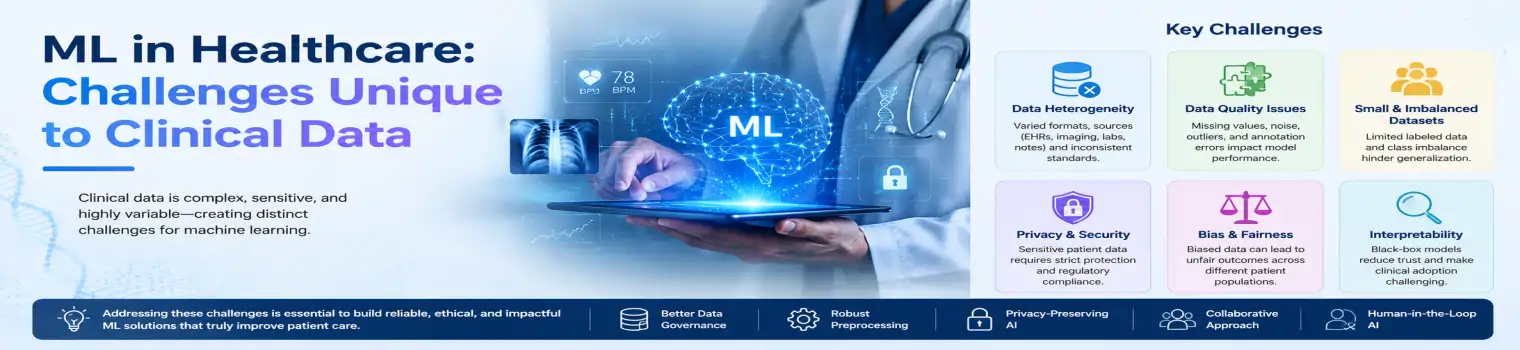
Hospitals, clinics, and research organizations generate enormous amounts of patient data every day. This information can help machine learning systems identify patterns that humans may miss. However, healthcare data is very different from data used in many other industries. Clinical data comes with unique challenges that make building reliable ML solutions much more difficult.
In this blog, we will explore the major challenges of using machine learning in healthcare and understand why clinical data requires special attention.
Why Machine Learning Matters in Healthcare
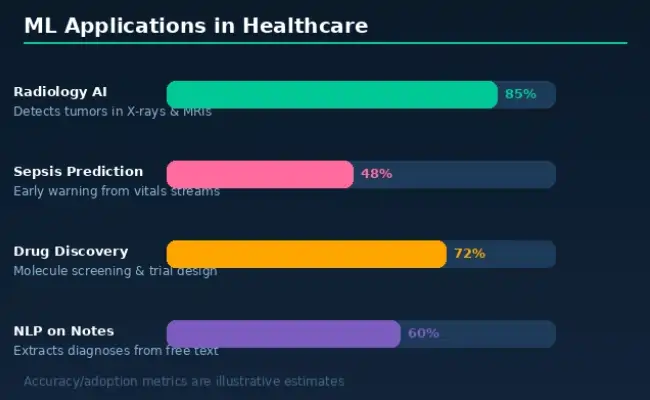
Machine learning enables computers to learn from data and make predictions. In healthcare, it can be used for:
- Disease diagnosis and prediction
- Medical image analysis
- Patient risk assessment
- Drug discovery
- Personalized treatment recommendations
- Hospital resource management
For example, an ML model can analyze thousands of X-ray images and help doctors identify signs of pneumonia more quickly. Similarly, predictive models can identify patients who may be at risk of developing chronic diseases such as diabetes or heart conditions.
While these applications are impressive, their success depends heavily on the quality of clinical data.
Challenge 1: Poor Data Quality
One of the biggest problems in healthcare is inconsistent data quality.
Patient records are often collected from different hospitals, departments, and medical devices. As a result, information may be:
- Incomplete
- Duplicated
- Incorrectly entered
- Stored in different formats
For instance, one hospital may record blood pressure differently from another. Missing or inaccurate information can reduce the performance of ML models and lead to unreliable predictions.
Before training a model, healthcare organizations spend a significant amount of time cleaning and organizing data.
Challenge 2: Privacy and Security Concerns
Healthcare data contains highly sensitive personal information.
Patient records include medical histories, diagnoses, laboratory reports, and treatment details. Protecting this information is essential.
Machine learning systems must comply with strict privacy regulations and security standards. Any data breach can harm patients and reduce trust in healthcare technology.
To address this challenge, researchers are developing privacy-preserving techniques such as:
- Data anonymization
- Federated learning
- Secure data sharing platforms
- Advanced encryption methods
These technologies allow ML systems to learn from data while protecting patient privacy.
Challenge 3: Limited and Imbalanced Data
Many diseases are relatively rare. As a result, hospitals may have only a small number of cases available for training machine learning models.
For example, if an ML system is trained using thousands of healthy patient records but only a few cases of a rare disease, it may struggle to recognize that disease accurately.
This issue is known as data imbalance.
Researchers often use data augmentation techniques and specialized algorithms to improve model performance when dealing with limited datasets.
Challenge 4: Unstructured Clinical Information
Not all healthcare data is neatly organized in tables.
Doctors frequently write notes describing patient conditions, symptoms, and treatment plans. Medical reports, prescriptions, and discharge summaries also contain valuable information in text form.
Machine learning models must process this unstructured data using technologies such as Natural Language Processing (NLP).
Understanding medical terminology, abbreviations, and handwriting can be difficult even for advanced AI systems. This makes clinical data analysis more complex than many other business applications.
Challenge 5: Trust and Explainability
In healthcare, decisions can directly affect human lives.
Doctors need to understand why an ML model makes a particular prediction. If a system recommends a treatment without providing an explanation, healthcare professionals may hesitate to trust it.
This challenge has increased interest in Explainable AI (XAI).
Explainable AI helps doctors see which factors influenced a prediction. Instead of acting as a “black box,” the system provides understandable insights that support clinical decision-making.
Real-World Applications
Despite these challenges, machine learning is already making a significant impact.
Medical Imaging
AI-powered systems can analyze X-rays, CT scans, and MRI images to assist radiologists in detecting abnormalities faster.
Early Disease Prediction
Hospitals use predictive analytics to identify patients at risk of heart disease, diabetes, and other chronic illnesses.
Personalized Healthcare
Machine learning helps doctors design treatment plans based on a patient’s medical history, genetics, and lifestyle factors.
Virtual Health Assistants
AI-based assistants can answer patient questions, schedule appointments, and provide basic healthcare guidance.
Emerging Trends and Innovations
Healthcare machine learning continues to evolve rapidly. Some exciting developments include:
Federated Learning
Hospitals can collaborate on AI projects without sharing sensitive patient data directly.
Generative AI in Healthcare
Advanced AI systems can summarize medical records, assist documentation, and support clinical workflows.
Digital Twins
Researchers are exploring virtual patient models that simulate treatment outcomes before real-world implementation.
AI Workshops and Training Programs
Medical institutions and engineering colleges are increasingly organizing workshops that teach healthcare professionals how to work with AI and data-driven technologies.
These initiatives are helping bridge the gap between healthcare expertise and modern technology.
Future Scope
The future of machine learning in healthcare is extremely promising. As data quality improves and privacy-preserving technologies become more advanced, ML systems will become more accurate, trustworthy, and accessible.
Future healthcare solutions may provide faster diagnoses, personalized treatments, and better patient outcomes while reducing the workload on medical professionals.
However, success will depend on responsible data management, ethical AI practices, and close collaboration between doctors, engineers, and researchers.
I am text block. Click edit button to change this text. Lorem ipsum dolor sit amet, consectetur adipiscing elit. Ut elit tellus, luctus nec ullamcorper mattis, pulvinar dapibus leo.
Closing Remarks
Machine learning has the potential to revolutionize healthcare, but clinical data presents challenges that cannot be ignored. Issues such as poor data quality, privacy concerns, limited datasets, and the need for explainable AI require careful attention.
By addressing these challenges and embracing new innovations, healthcare organizations can unlock the full power of machine learning and create smarter, safer, and more effective healthcare systems for everyone.